
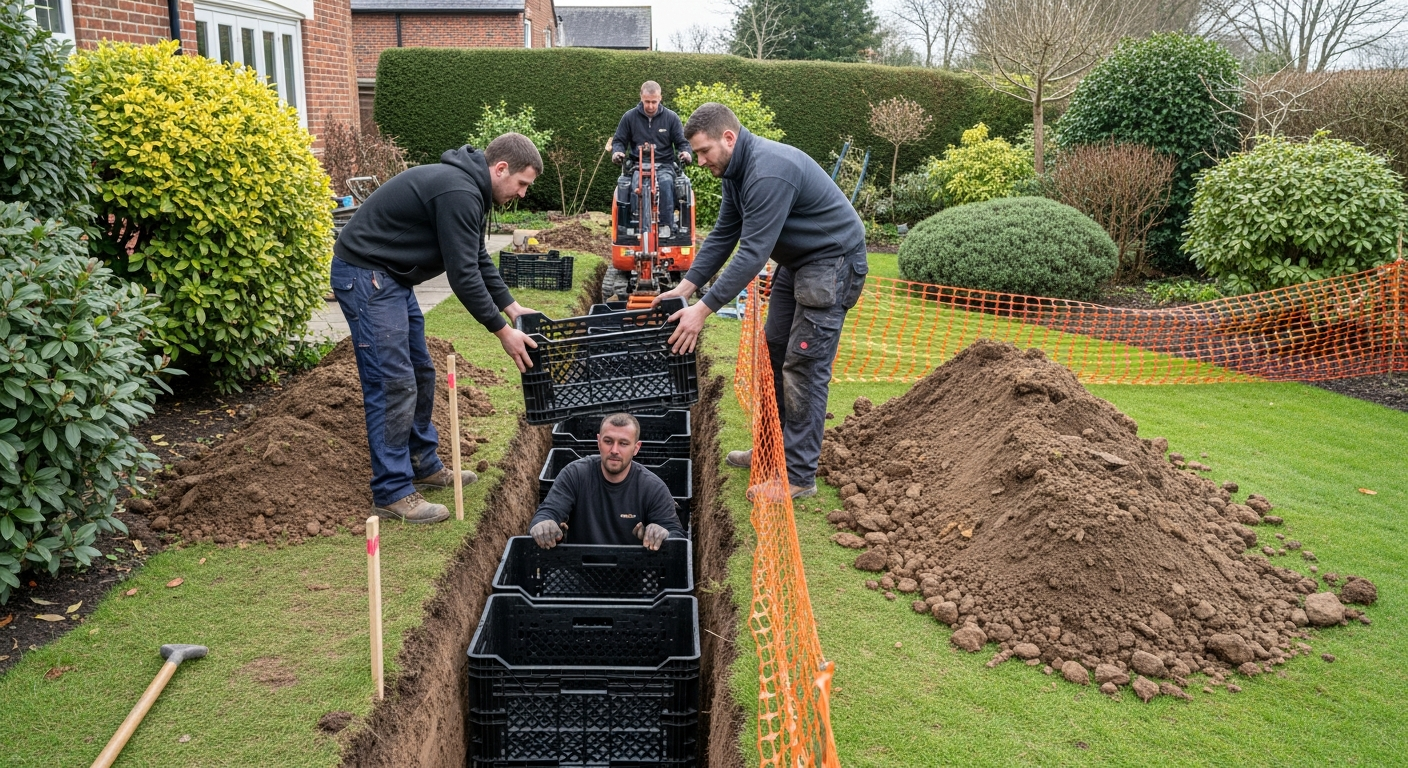
Soakaway Installation in Hampshire: What You Need to Know
Planning to install a soakaway in Hampshire? Understand the UK Building Regulations, soil testing requirements, and whether a soakaway is suitable for your property.
Managing surface water effectively is crucial to prevent localised flooding and protect your property's foundations. A soakaway is a common and highly effective method for dispersing surface water (rainwater from roofs and hardstanding areas) back into the ground. However, installing a soakaway in Hampshire requires careful planning and adherence to strict regulations.
A soakaway is essentially a large hole dug into the ground, traditionally filled with rubble or gravel, but increasingly constructed using modern, modular plastic crates. These crates create a large, void space underground that temporarily stores surface water during heavy rainfall, allowing it to slowly percolate into the surrounding soil.
Before any installation can begin, you must comply with UK Building Regulations, specifically Part H (Drainage and Waste Disposal). A fundamental requirement is a percolation test. This test determines the absorption rate of your soil; essentially, how quickly water drains away.
The varied geology of Hampshire makes the percolation test critical. In areas with chalky subsoils, such as the South Downs, drainage is generally excellent, and soakaways are highly effective. However, in areas dominated by heavy clay, such as parts of northern and eastern Hampshire, the soil is relatively impermeable. A soakaway installed in heavy clay will simply fill up like a bathtub and overflow, completely failing its purpose. If a percolation test fails, alternative drainage solutions must be sought.
There is a distinct difference between garden drainage (like French drains, used to manage soggy lawns) and a dedicated surface water soakaway designed to handle the massive volume of water shedding from a roof during a storm. Soakaways must be sized correctly based on the catchment area (the roof size) and the results of the percolation test.
Generally, planning permission is not required for a domestic soakaway on your own land, provided it is at least 5 metres away from any building or road, and 2.5 metres from any boundary. However, it is always advisable to check with your local authority.
Cost factors for installation include the size of the soakaway required, the ease of excavation (machine access to the garden), and the disposal of the excavated spoil. It is vital to consult with drainage experts who understand the local ground conditions in Hampshire to ensure a soakaway is a viable, compliant, and long-lasting solution for your property.
Need Help Now?
If you are dealing with a drainage emergency or need professional advice, our team is available 24/7.
Send us a message